


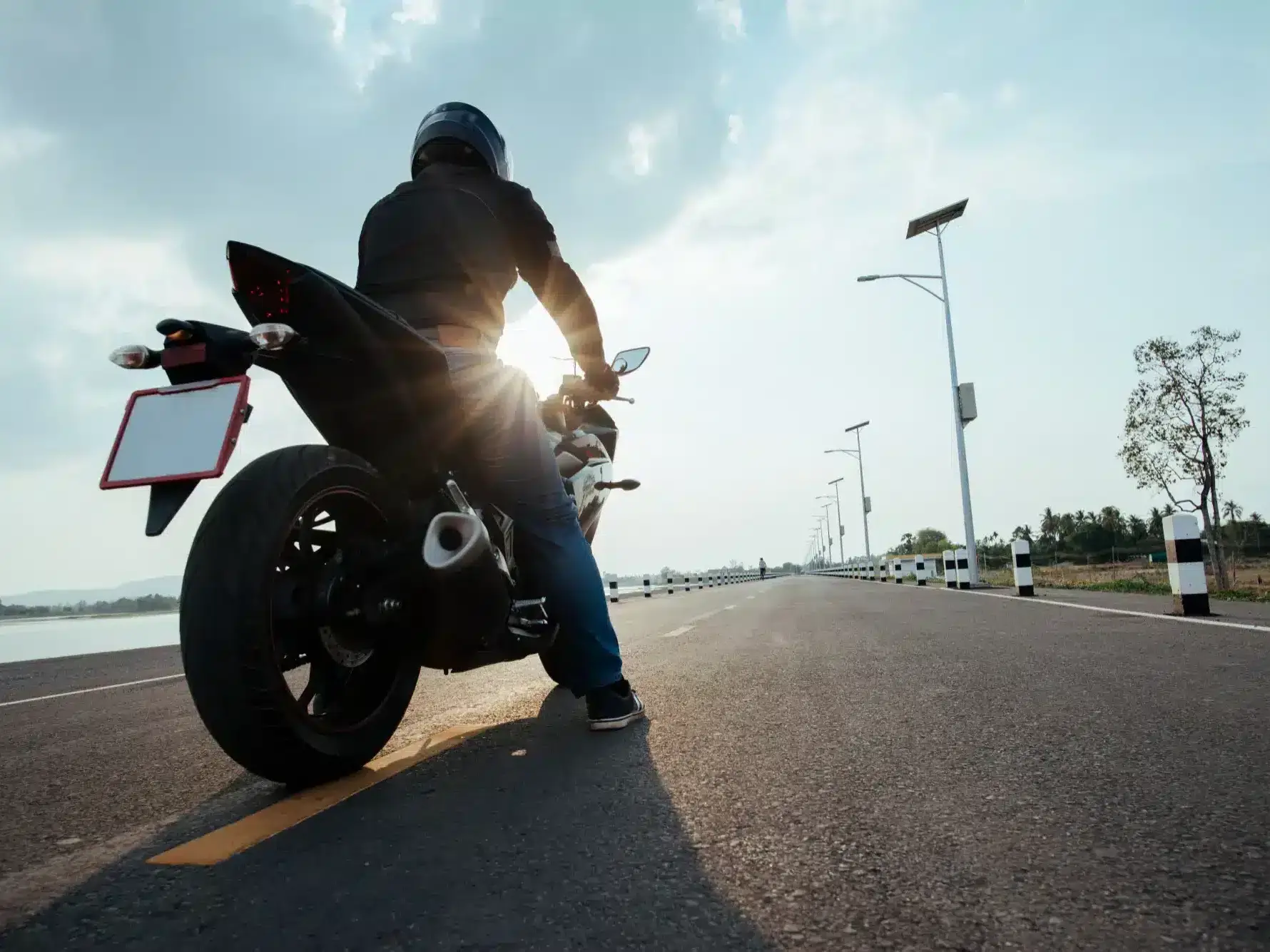
Motorcyclists are among the most vulnerable road users. Unlike the occupants of a car, they do not have a protective structure capable of absorbing impact energy. As a result, a fall or run-off-road collision can have particularly serious consequences.
The studies on motorcycle collisions on interurban roads published by Forenvision analyse accidents recorded between 2017 and 2024. They pay particular attention to run-off-road collisions, one of the most severe types of accident involving motorcycle users.
The figures illustrate the scale of the problem. In 2024, 478 motorcycle or moped users were killed in Spain, accounting for 26.8% of all road traffic fatalities. Spain also has more than 4.3 million registered motorcycles.
This situation makes it necessary to design roads that not only seek to prevent accidents, but also reduce their consequences when they occur.
Table of Contents
Toggle1. Run-off-road collisions: a particularly dangerous scenario
A vehicle may leave the road for many different reasons, including inappropriate speed, loss of grip, distraction, evasive manoeuvres, the condition of the road surface or complex road geometry.
For motorcyclists, the dynamics of a collision are usually different from those involving four-wheeled vehicles. After losing control, a rider may fall onto the carriageway and slide until they strike a safety barrier or another object located on the roadside.
Conventional steel safety barriers are designed to contain and redirect vehicles. However, their posts can become highly dangerous impact points for someone sliding along the ground. This risk is commonly known as the guillotine effect because of the high concentration of forces that may be exerted on the body.
Vehicle restraint engineering must therefore consider not only the behaviour of the vehicle, but also the possible interaction between the motorcyclist and the infrastructure. In this context, road restraint systems must be selected according to the type of road, its speed, the road users present and the foreseeable consequences of a vehicle leaving the carriageway.
2. What are Motorcycle Protection Systems?
Motorcycle Protection Systems, commonly known as MPS, are devices normally installed along the lower section of steel safety barriers.
Their purpose is to close the gap between the barrier and the ground, cover the posts and create a continuous longitudinal surface. This helps prevent direct impacts against rigid components and reduces the severity of injuries.
A properly designed MPS can:
- Prevent direct contact between the motorcyclist and the barrier posts.
- Reduce the presence of exposed edges and sharp surfaces.
- Distribute the impact across a larger surface.
- Guide the rider’s body along the system.
- Prevent the rider from passing underneath the barrier.
Metalesa has developed the Metaurban® steel parapet with a Motorcycle Protection System, a solution that combines vehicle containment with specific protection for road users who may slide along the carriageway after falling.
The application of these solutions is also discussed in the article Parapets also protect motorcyclists, which examines the need to incorporate systems adapted to this vulnerable group.
3. Where should MPS be installed?
The installation of Motorcycle Protection Systems should be based on a specific risk assessment. Not every section of road has the same characteristics or presents the same potential consequences.
Installation is particularly important in the following locations:
- Tight bends or sections with pronounced changes in alignment.
- Sections with a history of motorcycle collisions.
- Secondary roads frequently used by motorcyclists.
- Areas with changes in level, embankments or rigid obstacles.
- Interchanges, slip roads, merging lanes and exits.
- Sections where a loss of control could lead directly towards a barrier.
Secondary roads require particular attention because they often combine successive bends, narrow hard strips or verges, accesses, junctions and roadside objects close to the carriageway. These roads are also frequently used by motorcyclists, particularly at weekends and during leisure periods.
4. Continuity, terminals and transitions
The effectiveness of a restraint system does not depend solely on the central section of the barrier. Its ends, connections and transitions can also become critical points.
Barrier end terminals must prevent the beginning or end of the system from becoming a rigid obstacle during an impact. These devices are designed for installation at the ends of safety barriers and absorb part of the energy generated in a collision.
Similarly, transitions between restraint systems connect barriers or parapets from different product families or with different containment levels while maintaining an appropriate change in stiffness.
Projects intended to improve motorcyclist safety should assess the following elements together:
- The main safety barrier.
- The Motorcycle Protection System.
- The approach and departure terminals.
- The transitions between different systems.
- Roadside obstacles and changes in level.
- The space available for the system to deform.
A partial or incorrectly installed system may simply transfer the risk from one point to another. Protection must therefore remain continuous throughout the entire potential impact area.
The importance of addressing these points correctly is also discussed in the article about changes to the regulations governing safety barrier transitions and terminals.
5. Design, installation and maintenance
The performance of an MPS also depends on whether it is installed in accordance with the manufacturer’s specifications. Changes to its height, anchors, post spacing or connections may alter the response of the complete system during a collision.
Subsequent maintenance is equally important. Impacts, corrosion, unsuitable repairs or changes in ground level can reduce the effectiveness of the system.
Inspections should assess the condition of the rails, posts, bolts, anchors, terminals and transitions. They should also identify deformation, incompatible components or accumulations of soil and vegetation that could affect the device’s effective height.
6. Roads that are more forgiving of human error
Analysis of motorcycle collisions makes it possible to identify risk patterns and apply more effective measures. In run-off-road collisions, Motorcycle Protection Systems play an essential role in reducing the consequences of an impact against a steel safety barrier.
The objective is not simply to prevent the vehicle from leaving the carriageway. The infrastructure must also be prepared to protect the motorcyclist after a fall and prevent the restraint system itself from making the resulting injuries more severe.
At Metalesa, we design and manufacture road restraint systems adapted to the characteristics of each road. The use of MPS, safe terminals and properly designed transitions contributes to more forgiving roads that can reduce the severity of an accident when human error cannot be prevented.

Related articles
Summer driving risks and how infrastructure should respond
Summer changes the usual driving conditions. Long-distance journeys, traffic in tourist areas and overnight travel intended to avoid the hottest…

ITS could reduce serious run-off-road collisions by 60%
Run-off-road collisions are among the most serious types of accident on interurban roads. They occur when the driver loses control and the vehicle…
Connected Crash Cushions: The next step towards the Smart Road
The evolution towards connected mobility is transforming the landscape of our roads. Passive safety elements, traditionally static, are giving way to…
Fall protection: Road and urban railing, fencing and enclosures for height safety in public spaces
When we talk about infrastructure safety, the focus is often exclusively on the road. However, pedestrian safety in public spaces, stadiums,…