




The State Road Network (RCE), managed by the Directorate-General for Roads (DGC) of the Ministry of Transport and Sustainable Mobility (MITMA), faces an energy challenge of great magnitude. The energy efficiency strategy has become a priority to reduce high operating expenditure and align with the objectives of the ecological transition, based on technological modernization and advanced telemanagement.
1. Context and Magnitude of Energy Expenditure
The RCE’s electricity consumption is one of the largest in public administration. Historically, consumption has remained close to 145,000,000 kWh/year, with an associated cost of tens of millions of euros, underscoring the urgency of intervention.
1.1 Critical Distribution of Consumption
The interurban infrastructure shows an unbalanced consumption distribution, primarily concentrated in the lighting and operation of enclosed structures.
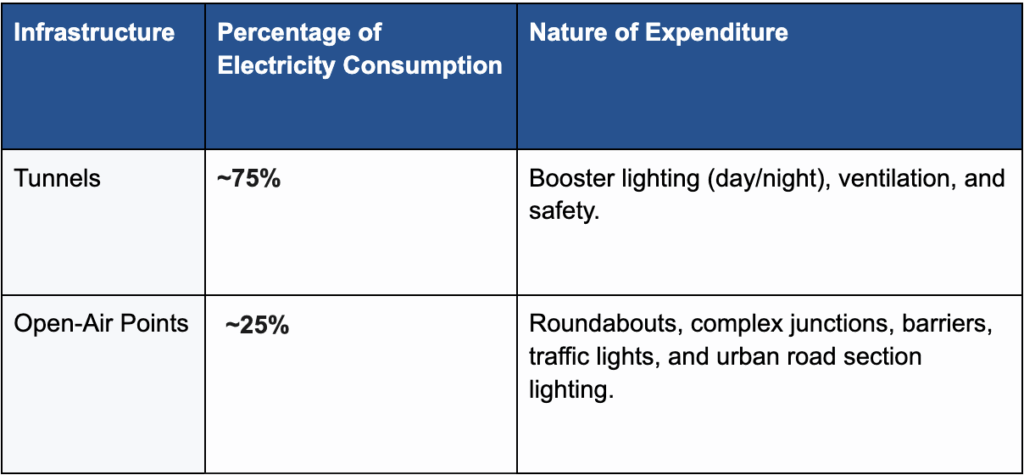
This dependence on consumption in tunnels (where lighting and ventilation are vital safety functions that cannot be interrupted) demands solutions of maximum efficiency that do not compromise visibility standards.
2. The Innovation Strategy (CPI) and the Three Lines of Action
The RCE’s strategy is articulated around Public Procurement of Innovation (CPI), a mechanism used by MITMA to promote technological solutions addressing its specific needs.
The central goal of the DGC is to achieve savings of between 40% and 50% of the network’s total consumption. This is achieved through coordinated action in three fundamental lines of action:
Axis 1: Luminaire Requirements (LED Migration)
The migration from obsolete technologies like high-pressure sodium lamps (VSAP) to LED technology is the first step, but it must meet advanced technical requirements to ensure long-term durability and efficiency in a demanding environment:
- Required Service Life: New luminaires are required to have a very high minimum service life, with certifications such as L90B10_100.000h. This means that only 10% of the units can have depreciated their luminous flux below 90% of their initial value after 100,000 hours of operation.
- Maintenance Reduction: High reliability is key to minimising interventions on the road, which are costly and dangerous.
Axis 2: Telemanagement and Dynamic Control (ITS)
The implementation of an Intelligent Management System (SGI) is essential to achieve savings targets through dynamic light adaptation.
- Standard Connectivity: The control nodes that allow remote monitoring and dynamic adaptation must be of an international standard, integrated using NEMA or Zhaga connectors.
- ITS Functionality: The SGI enables the dynamic adaptation of lighting in real-time to environmental and traffic conditions. During off-peak hours, intensity is reduced to pre-established levels, but the system must be capable of immediate re-activation when vehicles pass or in emergency situations (e.g., an accident warning or fog).
Descriptive Chart: RCE Saving Goal
- Baseline Consumption (Without CPI): 145.000.000 kWh/year
- Saving Target (40%): Reduction of 58.000.000 kWh/year
- Target Consumption: 87.000.000 kWh/year.
Axis 3: Road Safety and Strict Regulatory Compliance
On roads, lighting is a safety factor that must be managed with millimetre precision, especially at high speed. Therefore, regulatory compliance is non-negotiable and becomes the third strategic pillar:
- Luminance vs. Illuminance: Unlike urban roads (where illuminance is measured), on highways, average luminance (Lm) is prioritised, which is the light reflected from the pavement to the driver’s eye.
- Requirement Levels: Lighting solutions must guarantee the average luminance levels required by regulations, which range between 0.30 and 2.00 cd/m², depending on the type of road (motorway, conventional) and traffic intensity (IMD).
- Mitigation of Accident Risk: Efficient and reliable management of lighting at singular points is an unavoidable road safety priority. Studies like the one by INTRAS on run-off-road accidents have shown that the lack of lighting is a factor that significantly increases the risk and percentage of night-time accidents, justifying investment in intelligent and reliable systems at points where lighting is legally mandated.
3. Vision 2030: Digital Transformation and Sustainability
Smart road lighting in the RCE is not just a saving measure but a strategic component of the road network’s transformation:
- Sustainability: Energy saving contributes directly to the objectives of the RCE’s 2030 Energy Efficiency Strategy, minimising energy dependence and reducing the infrastructure’s carbon footprint.
- Big Data and ITS Integration: The lighting telemanagement nodes are transformed into a sensor network that can be integrated into the MITMA ITS ecosystem. This allows for the collection of environmental and traffic data at remote points, crucial for predictive infrastructure maintenance and informed decision-making in mobility planning.
In summary, the investment in adaptive lighting for the RCE represents a paradigm shift: from being merely an operating cost, lighting becomes an intelligent management asset that guarantees maximum safety and regulatory compliance with the minimum energy footprint.

Related articles
Connected Crash Cushions: The next step towards the Smart Road
The evolution towards connected mobility is transforming the landscape of our roads. Passive safety elements, traditionally static, are giving way to…

The data generated by the road: Intelligence applied to road safety and maintenance
The road is no longer a passive and static infrastructure but has become a dynamic, information-generating environment. In the era of connected…
The Importance of Preventive Maintenance in Road Safety: Prolonging the lifespan of infrastructures
Transport infrastructure management has undergone a paradigm shift over the last decade. Faced with the need to optimise public budgets and guarantee…