


A wildlife crossing can have the right width, topsoil and vegetation and still go unused. The problem usually lies at the edges. If animals on the crossing can see headlights and moving vehicles, many of them will avoid it.
That is why the technical guidelines of Spain’s Ministry for the Ecological Transition (MITECO) call for opaque side screens on green bridges and wildlife overpasses. They are a small element of the works, but they determine the return on the whole investment.
What a wildlife crossing is and the main types
A wildlife crossing is a structure that allows animals to cross a road or railway safely. Its purpose is to reduce the barrier effect of the infrastructure and habitat fragmentation, and to guide animals away from the carriageway.
It does not work on its own: it forms a system with the perimeter fencing, which keeps animals off the road and leads them towards the crossing. If either part fails, the whole system fails.
Crossings can be underpasses, beneath the road, or overpasses, above it. This article focuses on overpasses, where side screens are decisive. The MITECO guidelines distinguish three types:
- Green bridge (ecoduct): the largest type, with a minimum width of 80 m. It restores vegetation on the deck and gives continuity to the habitat on both sides, so it serves all terrestrial fauna, from ungulates to small vertebrates.
- Dedicated wildlife overpass: narrower, with a minimum width of 20 m and a recommended width of 40 to 50 m. It is reserved for animals.
- Multi-purpose overpass: shared with other uses, such as rural tracks or livestock droving routes, and adapted so that wildlife can use it too.
In all three cases, MITECO requires opaque screens along the edges. The size of the structure changes; the need to hide the traffic does not.
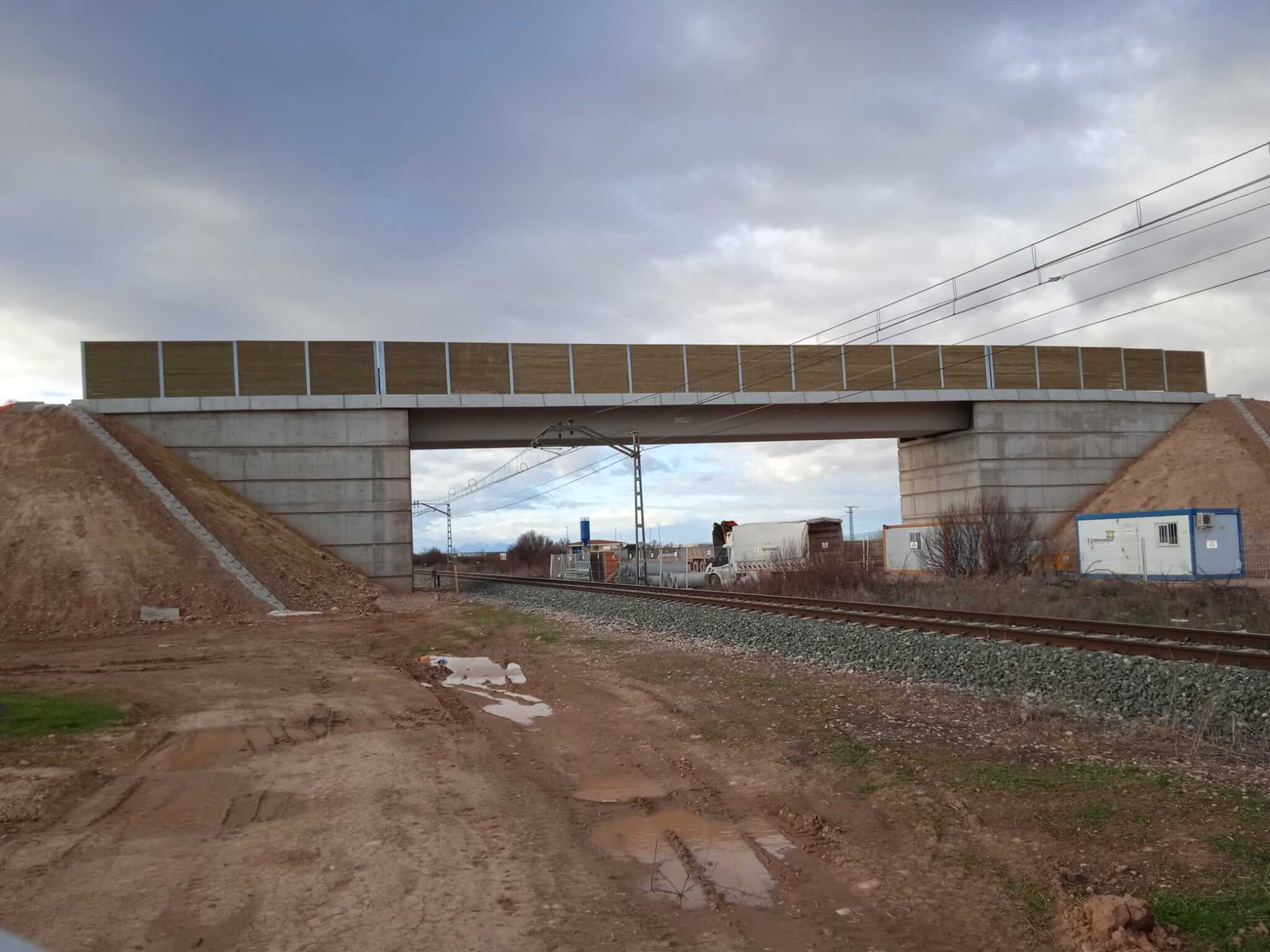
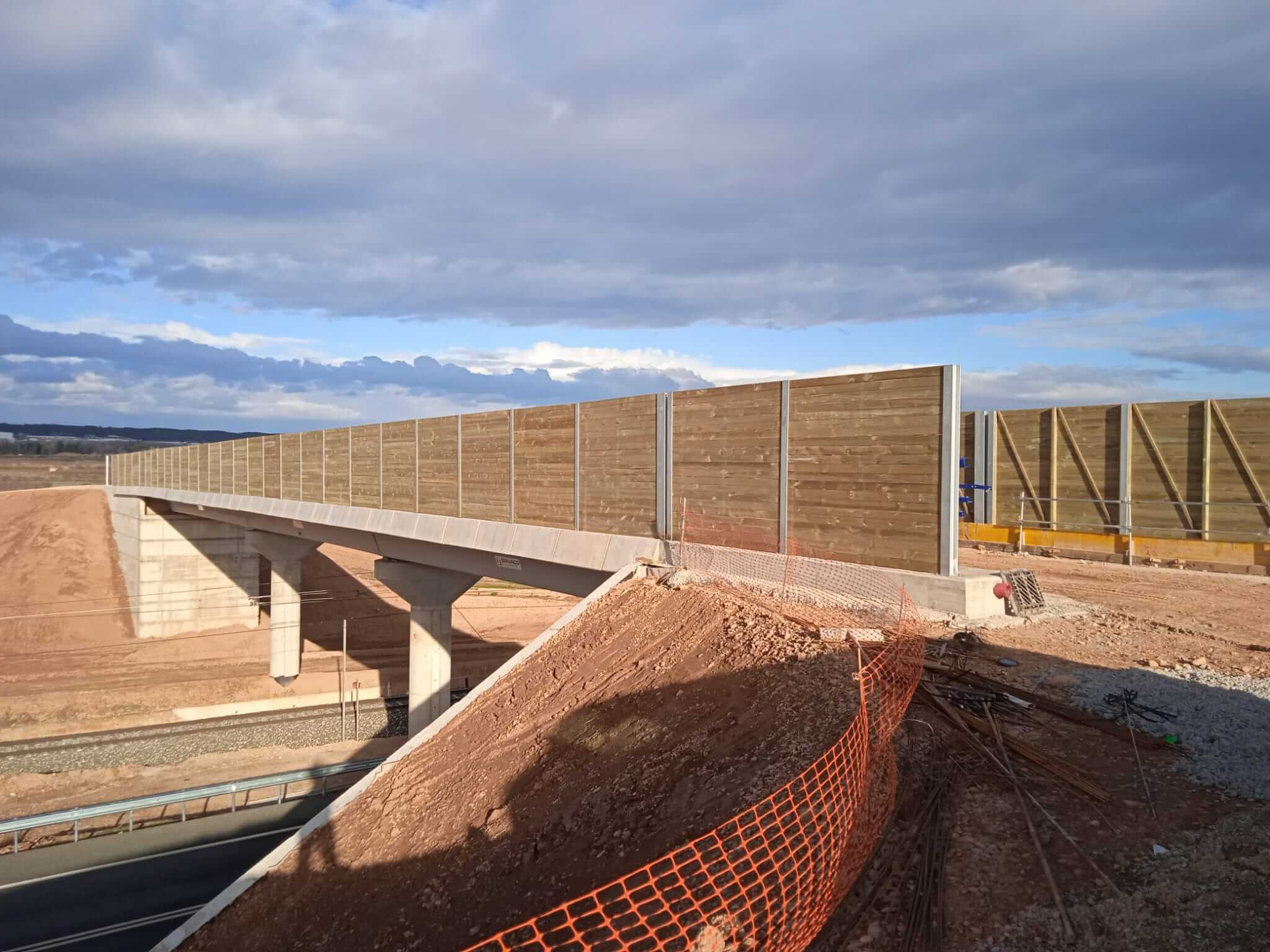
Why a wildlife crossing stops working
The Ministry’s guidelines put it simply: the disturbance caused to animals by the sight of vehicle lights and by traffic noise must be reduced. A deck left open to the carriageway exposes wildlife at the very point where it should feel safe.
The second common failure is discontinuity. If there is a gap between the screen and the perimeter fencing, the crossing no longer guides animals and may even lead them onto the carriageway.
What the MITECO technical guidelines require
The reference document in Spain is Prescripciones técnicas para el diseño de pasos de fauna y vallados perimetrales (Technical guidelines for the design of wildlife crossings and perimeter fencing, MITECO, 2nd revised and expanded edition, 2015). For overpasses, it sets out:
| Requirement | What the guidelines state |
|---|---|
| Type of screen | Fully opaque, or dense shrub planting |
| Height | At least 2 m |
| Continuity | No break with the road’s perimeter fencing |
| Materials | Treated timber, tinted concrete or metal, with high durability |
A built screen is opaque from day one. Planting takes time to become dense enough and needs maintenance.
The guidelines also specify how these screens apply to each type of overpass:
| Type of crossing | What they state for the screens |
|---|---|
| Green bridge | Fully opaque screens or dense planting that continue the perimeter fencing along the edges. In arid areas, where dense vegetation is difficult, an opaque fence does both jobs: it screens and it closes the crossing. |
| Dedicated wildlife overpass | Opaque screens along the side edges, fully continuous with the road’s fencing. On large crossings they can be replaced by dense shrub planting combined with mesh fencing. |
| Multi-purpose overpass | Opaque screens of treated timber, or tinted concrete panels where greater durability is required. |
Two ideas recur in every section. First, the screen and the perimeter fencing form a single continuous element with no gaps between them. Second, durability of the material matters, because a deteriorated screen leaves the traffic in view again.
The guidelines add a complementary use: screens can carry information panels about the local biodiversity.
Timber screens for wildlife crossings: Metalesa’s solution
Metalesa’s wildlife crossing panel meets these requirements with one of the materials recommended by MITECO: treated timber. It is designed for wildlife overpasses and for livestock crossings on droving routes, and it stops animals crossing from seeing the traffic on the road below.
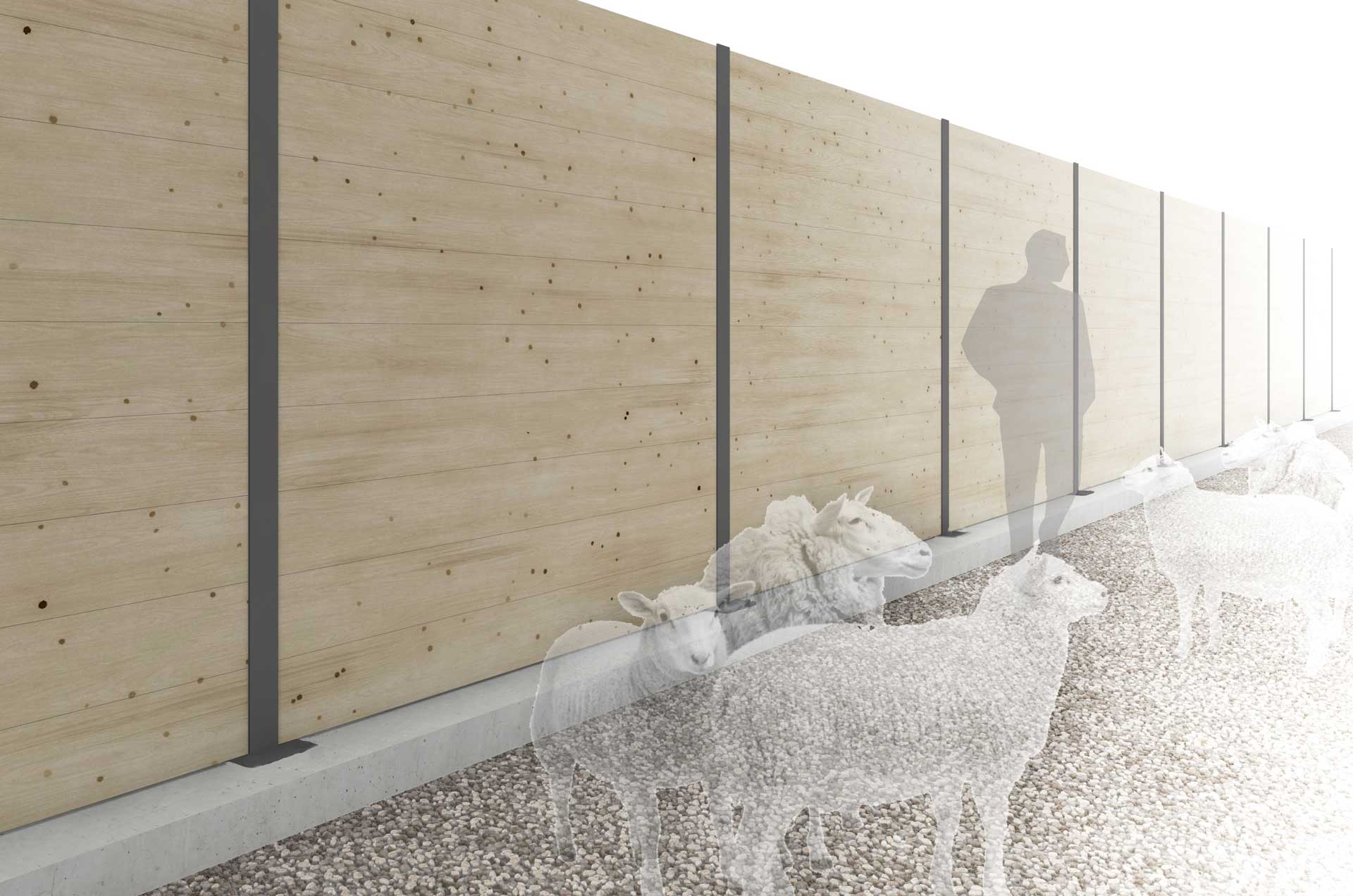
This is how it is built:
- Timber panel: boards or logs industrially treated in an autoclave (classes C3/C4) with water-soluble salts free of arsenic and chromium. The treatment protects the timber outdoors and is environmentally friendly.
- Support structure: HEA/HEB steel sections. The panels slide into place between the sections and adapt to different section widths.
- Corrosion protection: the metal parts are hot-dip galvanised to UNE-EN 1461 and can be finished with polyester powder coating to UNE-EN 15773. You can see all the options in our anti-corrosion treatments.
- Dimensions: variable thickness, height and length, made to measure for each crossing. This makes it possible to meet the 2 m minimum height and keep continuity with the perimeter fencing.
Compared with other solutions, timber offers two advantages on this type of project:
- Landscape integration: a natural material that blends with the vegetation restored on the crossing.
- Immediate opacity: it hides the traffic from the day it is installed, without waiting for planting to grow.
This solution is installed on the A-68 motorway, Gallur–Mallén section.
Visual screening and noise protection: a solution for each requirement
The Ministry’s guidelines mention both lights and noise. Metalesa’s range has a solution for each, and both can be combined on the same crossing: the wildlife crossing panel provides visual screening and noise barriers provide noise reduction.
When the environmental or acoustic study sets a noise target, Metalesa offers noise barriers for roads tested to EN 1793. To keep a timber look across the whole crossing, the METAWOOD acoustic panel combines treated timber with a rock wool core: sound absorption DLα 9 dB and airborne sound insulation DLR 31 dB.
Key points when designing screens for a wildlife crossing
- Full opacity on both edges. The screen must not let animals see headlights or moving vehicles. A screen with gaps or transparent sections loses its purpose.
- Minimum height of 2 m. This is the height set by MITECO for green bridges and wildlife overpasses. Below it, the traffic remains visible from the crossing.
- Gap-free continuity with the perimeter fencing. Screen and fencing work as a single element. Any gap where they meet can lead animals onto the carriageway.
- Durable material and corrosion protection. The screen is exposed to the weather for the whole life of the structure. Autoclave-treated timber and a galvanised structure reduce maintenance.
- Landscape integration. The crossing should look like part of its surroundings, not an add-on. Timber blends with the vegetation restored on the deck.
- Noise protection where the study requires it. If a noise target is set, a noise barrier tested to EN 1793 is added, such as the METAWOOD panel.
Wildlife does not only cross on the ground. On stretches with bird activity, bird collision screens complete the protection.
Are you designing a wildlife crossing? Contact our technical team to size the screens for your project.

Related articles
High-security fencing to protect railway lines against trespassing and vandalism
The safety of railway infrastructure does not depend on a single component. Stations, tracks, overpasses, bridges and areas close to the overhead…
Concrete barriers and steel systems: how to connect them without creating a hard spot
Many roads combine two types of restraint system: the concrete barrier, which hardly deforms at all, and the steel bridge parapet or safety barrier,…
Why speed-related risks require high-containment vehicle restraint systems
Inappropriate speed reduces the time available to react, increases the distance required to stop a vehicle and worsens the consequences of a…
Safe design of diverging junctions: crash cushions, barrier terminals and gore nose protection
During the holiday getaway period, traffic increases at junctions and access roads that many drivers are unfamiliar with. A late instruction from a…